
Reducing AKI in PCI Patients: A Data-Driven Partnership with Duke Heart Network

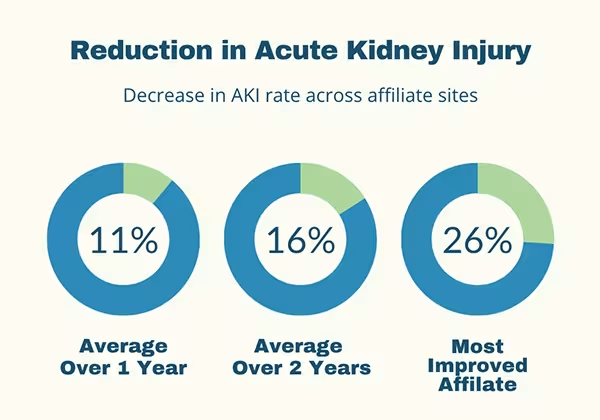
Duke Heart Network partners with hospitals to reduce contrast-induced acute kidney injury (AKI) in patients. By working hand-in-hand within hospital teams, Duke provides real-time monitoring, multidisciplinary collaboration, and sustainable strategies that enhance patient safety, improve quality metrics, and optimize healthcare efficiency.

At Duke Heart Network, we know that real progress in patient care comes from collaboration. That’s why we work alongside hospitals and healthcare institutions to implement data-driven improvement strategies that optimize outcomes, reduce costs, and enhance patient safety.

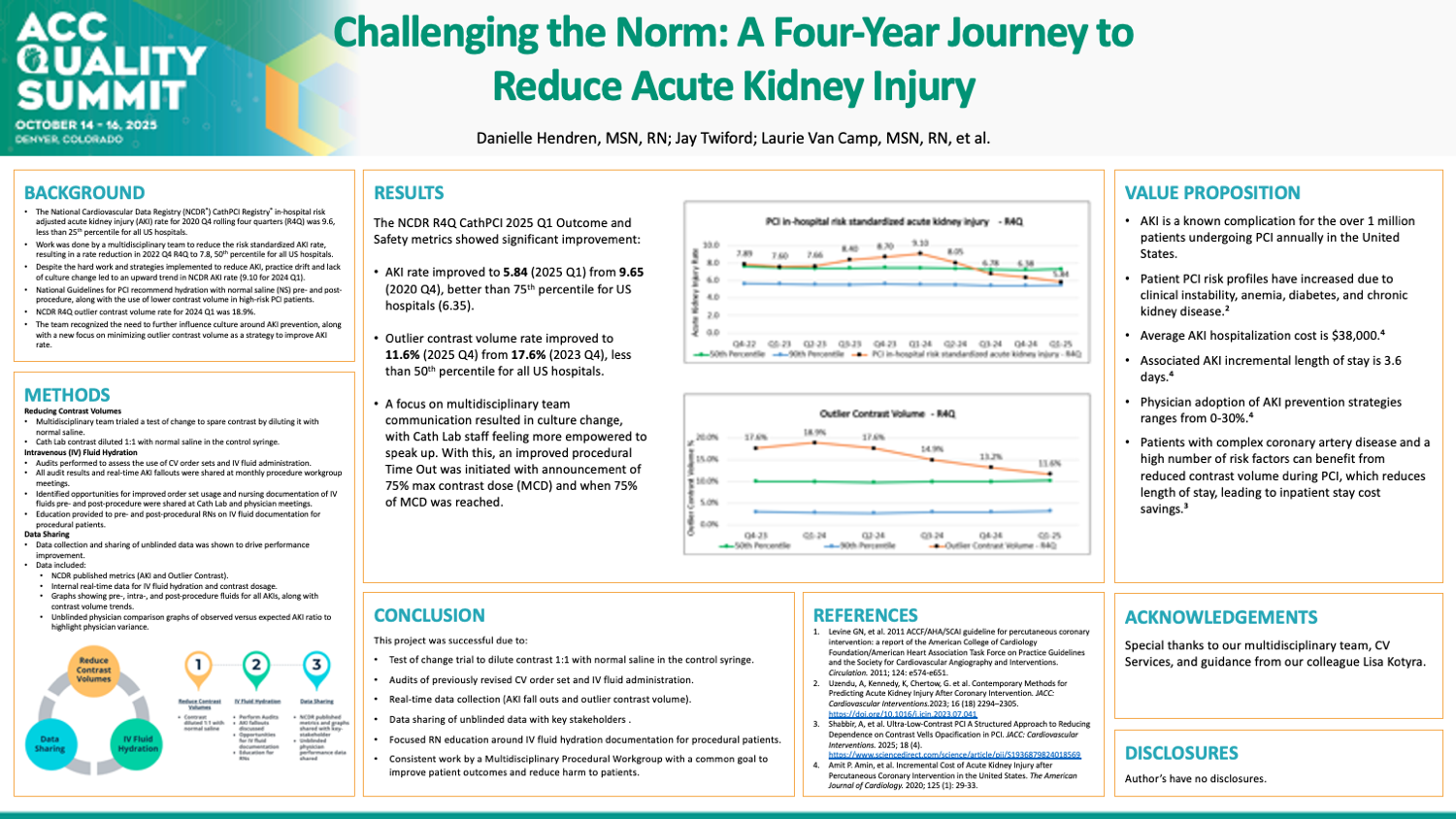
One of the most critical challenges we help hospitals address is reducing contrast-induced acute kidney injury (AKI) in percutaneous coronary intervention (PCI) patients. By refining prevention strategies, hospitals not only improve patient safety but also strengthen performance in national benchmarks such as the National Cardiovascular Data Registry (NCDR®) CathPCI Registry®.

Why AKI prevention matters

AKI prevention isn’t just about improving clinical outcomes—it’s about making a real difference in patient care while reducing the financial strain on healthcare systems. The data speaks for itself:

  • Hospitalization costs for AKI patients nearly double, averaging $38,869 compared to $17,1671
  • AKI extends hospital stays by an average of 3.6 days, adding resource burdens¹
  • The estimated U.S. healthcare cost burden exceeds $1.67 billion annually²
  • Hospitals participating in CMS’s Bundled Payments for Care Improvement Advanced model can significantly improve cost efficiency through AKI reduction strategies
  • The 50th percentile AKI rate for PCI patients is 7.3%, leading to increased complications³

With so much at stake, the need for a structured, multidisciplinary approach to AKI prevention has never been more critical.

The Duke Heart Network approach

At Duke Heart Network, we don’t just provide recommendations—we embed ourselves within hospital teams to create sustainable, long-term improvements. Our process includes:

  • A Comprehensive Cath Lab Assessment – We evaluate hydration protocols, pre-procedure lab testing, and contrast administration strategies to identify improvement opportunities.
  • Multidisciplinary Collaboration – Bringing together physicians, nurses, and quality improvement specialists, we develop targeted intervention strategies using real-time data analysis.
  • Real-Time Monitoring and Benchmarking – Key metrics such as contrast use, left ventriculogram rates, and hydration compliance are tracked to measure success.
  • Physician and Nursing Leadership Engagement – We identify champions within the hospital to drive best-practice adoption and long-term sustainability.
  • Transparency and Accountability – Unblinded provider comparisons encourage a culture of continuous quality improvement.
  • Recognition and Impact – We collaborate with hospitals to submit project abstracts to quality conferences, highlighting their commitment to patient care excellence.

A partnership that delivers results

By taking a hands-on, data-driven approach, Duke Heart Network empowers hospitals to reduce AKI complications, improve quality metrics, and enhance financial performance. When healthcare institutions partner with us, they gain access to a team of experts, proven methodologies, and the tools necessary to create lasting, meaningful change. AKI prevention is more than an initiative—it’s an investment in better patient outcomes and a stronger healthcare system.

References:

  1. Amin, A.P., et al. (2020). Incremental Cost of Acute Kidney Injury After Percutaneous Coronary Intervention in the United States. The American Journal of Cardiology, 125(1), 29-33
  2. Prasad, A., et al. (2020). Contemporary Trend of Acute Kidney Injury Incidence and Incremental Cost Among U.S. Patients Undergoing Percutaneous Coronary Procedures. Catheterization and Cardiovascular Interventions, 96(6), 1184-1197
  3. National Cardiovascular Data Registry (NCDR®) CathPCI Registry® – Contrast-induced acute kidney injury (AKI) rates and benchmarking data


Building Meaningful Partnerships: How Baystate Medical Center and Duke Heart Network Transformed Patient Care

Baystate Medical Center partnered with the Duke Heart Network to drive lasting improvements in cardiovascular care, focusing on patient outcomes, operational efficiency, and team collaboration. Through a hands-on, data-driven approach, Duke became an extension of Baystate’s team, fostering a trusted partnership that continues to shape meaningful, long-term success.

When Baystate Medical Center set out to enhance its cardiovascular program, the goal wasn’t just incremental improvement, it was lasting transformation. Through a dynamic partnership with the Duke Heart Network, Baystate has achieved measurable advancements in patient outcomes, operational efficiency, and team collaboration.

At the heart of this success is a relationship built on trust, transparency, and a shared commitment to progress. Rather than a one-size-fits-all consulting approach, Duke Heart Network embedded itself as an extension of Baystate’s team, providing tailored strategies and hands-on support to drive meaningful change.

A foundation of trust and collaboration

Baystate leaders recognized this was not just another external evaluation. Instead, it was a true partnership.

“From the beginning, it was clear that this wasn’t just an evaluation, it was a relationship,” said Sheila Shoemaker, MS, AGACNP, Director of Heart & Vascular Ambulatory Services. “The Duke team wasn’t just checking boxes; they were listening, collaborating, and working with us to solve real challenges.”

Cassandra Crowal, MM, BA, FACHE, VP of Service Line Strategy, who joined the collaboration later, immediately noticed Duke’s commitment to integration, “They made us feel like an extension of their own team. It never felt like they were outsiders giving us recommendations—it felt like they were in it with us, genuinely invested in helping us succeed.”

This shared commitment to transparency and problem-solving created an environment where real progress could take shape.

Leveraging data to drive results

One of the most impactful aspects of this partnership was the strategic use of data. Rather than simply presenting metrics, Duke Heart Network worked closely with Baystate to translate data insights into meaningful, actionable improvements. A focus on staffing models and the role of advanced practice providers (APPs) became a key driver of success. With Duke’s guidance, Baystate refined its approach to optimize efficiency while maintaining the highest standard of patient care.

“They weren’t just throwing numbers at us,” Cassandra explains. “They took the time to help us understand the ‘why’ behind the data, which made it easier to get buy-in from the team and implement real, lasting improvements.”

A supportive, solutions-oriented approach

Beyond technical expertise, Duke’s collaborative approach fostered a culture of shared problem-solving. Instead of pointing out flaws, they worked side by side with Baystate’s team to create solutions.

“There was never a sense of ‘you’re doing this wrong,’” Sheila says. “Instead, it was, ‘Let’s figure out together how to make this better.’ That made all the difference in getting people engaged and invested.”

Duke’s ongoing support ensured that recommendations weren’t just theoretical—they were implemented, refined, and sustained for long-term success.

A partnership built for the future

Looking ahead, Baystate leaders are confident that the impact of their work with Duke Heart Network will continue to grow. The collaboration has strengthened not only patient care but also team cohesion and operational efficiency.

For hospitals considering a partnership with the Duke Heart Network, Sheila describes the experience as: “Open, honest, transparent, collaborative. They push you to be better, but they do it in a way that’s supportive and achievable.”

Cassandra sums it up simply: “This wasn’t just a consulting relationship—it was a true partnership. And that’s what made all the difference.”

Through data-driven strategies, open communication, and a commitment to shared success, Duke Heart Network has proven to be more than an advisor—it’s a dedicated partner in driving real, lasting change.

Launching a TAVR Program at Frye Regional Medical Center

Frye Regional Medical Center, in partnership with the Duke Heart Network, launched a local transcatheter aortic valve replacement (TAVR) program to enhance cardiovascular care and reduce patient travel. Despite pandemic challenges, the program successfully performed its first procedure in June 2024, achieving excellent clinical outcomes and serving 60 patients in its inaugural year. 

Goal

Anchored by a 355-bed acute care hospital, Frye Regional Medical Center serves more than 300,000 residents of the Catawba Valley region of western North Carolina. Frye Regional has a longstanding reputation of providing cardiovascular care; including open heart surgery. As technological advances have become more prevalent in the field of cardiology, patients requiring the newest catheter-based heart valve procedures were traveling at least an hour to seek care at larger tertiary care centers. Building a new, local cardiovascular service line offering became a key strategic initiative for the physicians and executive team at Frye Regional.

As a Duke Health affiliate in heart, Frye Regional partnered with the Duke Heart Network to develop a structural heart program that would offer transcatheter aortic valve replacement (TAVR) as the initial service offering.

“Bringing a service like this to our community is challenging,” says interventional cardiologist John Morrison, MD, Frye Regional Medical Center. “The ability to offer our patients this procedure without them having to go out of town is immensely valuable.”

Solution

The Duke Heart Network began with a comprehensive site assessment, meeting with clinical and executive leadership to understand their objectives and evaluate strengths and challenges facing the launch of a new structural heart program. This onsite visit included Duke Heart Center clinical experts and identified needs in imaging, OR construction, provider and team training, and incremental staff requirements. The Duke Heart Network then worked collaboratively with key stakeholders to create the project timeline.

Despite many pandemic related delays, the Duke Heart Network served as project managers, overseeing the project charter and organizing each phase of program development. The Duke Heart Center welcomed Frye Regional staff and providers for clinical shadowing experiences that provided the education and mentorship required to develop their own program at Frye Regional.

Jessica Prevette, FNP, TAVR Coordinator for Frye Regional Medical Center, says “The Duke Heart Network’s ability to assess where we were, identify opportunities and then provide tools and feedback was key to a successful launch. We had a good first day because there was a ton of preparation on our part with Duke’s help and leadership.” Prevette said the connections she made while working with Duke helped her not only develop her new role, but establish protocols and standardization for the new program.

Through our partnership, the Duke Heart Team was able to provide experiential leadership in avoiding common pitfalls of a new TAVR program. “I think one of the most underrated tools Duke offers is their willingness to gently apply the brakes,” says Brett Starr, MD, Chief, Division of Cardiovascular and Thoracic Surgery, Frye Regional Medical Center. “What I mean by that is we wanted to push forward…Duke identified areas where we needed to pause to ensure a successful launch.” Dr. Morrison agreed, “…Duke’s program development approach allowed us to sit back and look at things more objectively before moving forward and this was extraordinarily helpful. The last thing you want to do is start a program that fails.”

“The most valuable service the Duke Heart Network provided was to allow the Frye providers to focus on being clinicians,” says Lisa Kotyra, ACNP, Senior Director of the Duke Heart Network. “Frye strategically prioritized the TAVR program development. We took on the work of project management: organization, scheduling, facilitation, and multidisciplinary team training. The Frye providers were able to continue caring for cardiac patients and still establish a needed service for patients and the community.”

Outcome

The Ambulatory Valve Clinic was launched in 2023 at Frye Regional Medical Center. And with this, Frye Regional performed the first TAVR procedure in June 2024 and to date is nearing 40 catheter based TAVR procedures. The clinical outcomes are excellent and the community is grateful for this service being added to the cardiovascular care already being offered at Frye Regional.